
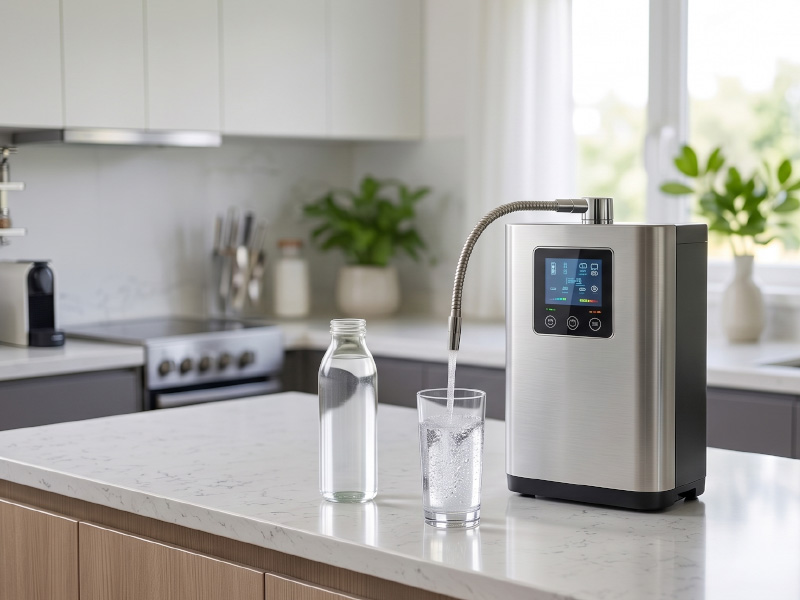
What Is an Alkaline Water Ionizer and How Does It Differ from a Regular Water Filter?
20 Jul 2026 · 5 min read
When people start exploring water quality options for their home, two terms often come up close together: water filter and alkaline water ionizer. At first glance, both sound like they do similar things. Both are connected to your water supply, and both are positioned as a way to improve your drinking water. However, the way each device works, and what it actually does to water, is quite different. Understanding that distinction helps you decide which, if either, suits your household's needs.
What a Regular Water Filter Does
A water filter, in general terms, is a device that removes unwanted substances from water. Depending on the type of filter technology used, this can include sediment, rust, chlorine, certain bacteria, and other particles that may be present in the supply water. The filtered water that comes out is cleaner in the sense that those specific impurities have been reduced or removed, but the water's basic chemical nature, including its pH level and mineral composition, remains largely unchanged.
Common household water filters use methods such as activated carbon to reduce chlorine and odour, sediment filters to trap particles, or membranes that physically block impurities as water passes through. The primary goal of a standard water filter is removal: it takes things out of the water.
What an Alkaline Water Ionizer Does
An alkaline water ionizer takes a different approach entirely. Rather than focusing on removing contaminants, its main function is to change the water's pH through a process called electrolysis. Here is how it works in straightforward terms.
Water contains hydrogen and oxygen molecules. When water passes through an ionizer, it flows over electrically charged electrode plates inside the unit. This electrical charge causes a separation: water on one side of the chamber becomes alkaline (with a higher pH), while water on the other side becomes acidic (with a lower pH). The alkaline output is what you drink, while the acidic output can be used for other purposes such as cleaning or rinsing.
The pH scale runs from 0 to 14, with 7 being neutral. Regular tap water in Malaysia generally sits close to neutral, though this can vary slightly by area. Alkaline water produced by an ionizer has a pH above 7, meaning it is less acidic than standard water. The degree of alkalinity can typically be adjusted on most ionizer units by selecting different output settings.
Importantly, an alkaline water ionizer usually includes a built-in filter stage, most commonly activated carbon, that removes chlorine and sediment before the electrolysis process begins. This filter stage is a preparatory step, not the main function. The defining feature of an ionizer is the electrolysis and pH change, not the filtration alone.
The Core Difference in Practical Terms
The simplest way to separate the two is this: a water filter changes what is in the water, while an alkaline water ionizer changes the nature of the water itself.
A filter removes: sediment, rust, bacteria, chlorine, and similar impurities.
An ionizer restructures: it uses electrical current to shift the water's pH and produce alkaline output.
If you install a standard water filter, you will get water with reduced impurities but largely the same chemical properties as before. If you install an alkaline water ionizer, you will get water that has been electrically processed to carry a different pH, alongside a basic level of filtration as part of the process.
It is also worth noting that the two are not mutually exclusive. Many households in Malaysia use an outdoor or indoor water filter alongside an alkaline water ionizer, since the filter handles whole-home or drinking-point filtration while the ionizer provides a specific type of processed water for daily drinking use.
What to Consider When Choosing
Before deciding whether an alkaline water ionizer is the right addition to your home, a few practical considerations are worth thinking through.
Household intention. Are you looking for cleaner water generally, or are you specifically interested in water with adjusted pH? If the goal is simply to remove sediment and impurities, a standard water filter or purifier may be sufficient. If you want alkaline water specifically, an ionizer is the device designed for that purpose.
Plate count and build quality. In an alkaline water ionizer, the electrode plates are the core component responsible for the electrolysis process. Higher-quality ionizers typically use platinum-plated titanium plates, which are durable and resistant to corrosion. More plates generally allow for a more stable and adjustable ionization output across different pH settings.
Multiple output settings. A quality ionizer allows you to choose between different alkaline levels, a neutral or purified mode, and an acidic output. This gives the unit versatility for different uses around the home.
Intact Water's Ionizer Range
Intact Water carries a range of water treatment systems that cover different approaches to improving daily drinking water quality, from whole-home outdoor filtration to indoor purifiers, hydrogen water dispensers, and water ionization solutions. If you are exploring an alkaline water ionizer specifically, Intact Water's team can walk you through the current options available, help assess which system suits your household's water setup, and advise on whether an ionizer, a hydrogen water system, or a combination approach makes the most practical sense for your home.
Final Thoughts
A water filter and an alkaline water ionizer are built around fundamentally different technologies and serve different purposes. One focuses on removing what should not be in your water, and the other focuses on changing how the water itself is structured through electrolysis. Understanding that difference is the most useful starting point for making a decision about which device belongs in your home.
Frequently asked questions
Does an alkaline water ionizer also filter out bacteria and sediment like a regular water filter?
Most alkaline water ionizers include a built-in filter stage, typically activated carbon, that reduces chlorine and sediment before the electrolysis process begins. However, this pre-filter is a preparatory step rather than a full multi-stage filtration system, so it should not be treated as a complete substitute for a dedicated water purifier.
What does pH mean and why does it matter in drinking water?
pH is a scale from 0 to 14 that measures how acidic or alkaline a liquid is, with 7 being neutral. Regular tap water generally sits close to neutral, while an alkaline water ionizer raises the pH above 7 through electrolysis. Understanding pH helps explain why an ionizer produces water with different properties compared to standard filtered water.
Is alkaline water the same as mineral water?
No, they are different. Mineral water contains naturally occurring minerals from its source and may have a slightly higher pH depending on its composition. Alkaline water from an ionizer gets its higher pH through electrolysis rather than from dissolved minerals, so the two products are produced through entirely different processes.
Should I use an alkaline water ionizer instead of a water purifier, or do I need both?
The two devices serve different purposes and can complement each other. A water purifier focuses on removing impurities and providing clean drinking water, while an alkaline water ionizer changes the water's pH through electrolysis. Many households choose to use both, allowing the purifier to handle whole-home or drinking-point filtration while the ionizer provides specifically processed alkaline water.
Does the quality of tap water in Malaysia affect how well an alkaline water ionizer performs?
Yes, incoming water quality can influence ionizer performance. Higher levels of chlorine or sediment in the supply water put more demand on the built-in pre-filter and may affect the consistency of the electrolysis output. This is one reason why pairing an ionizer with a good quality pre-filtration system is often recommended for Malaysian households.